Childhood Immunization Schedule in the News
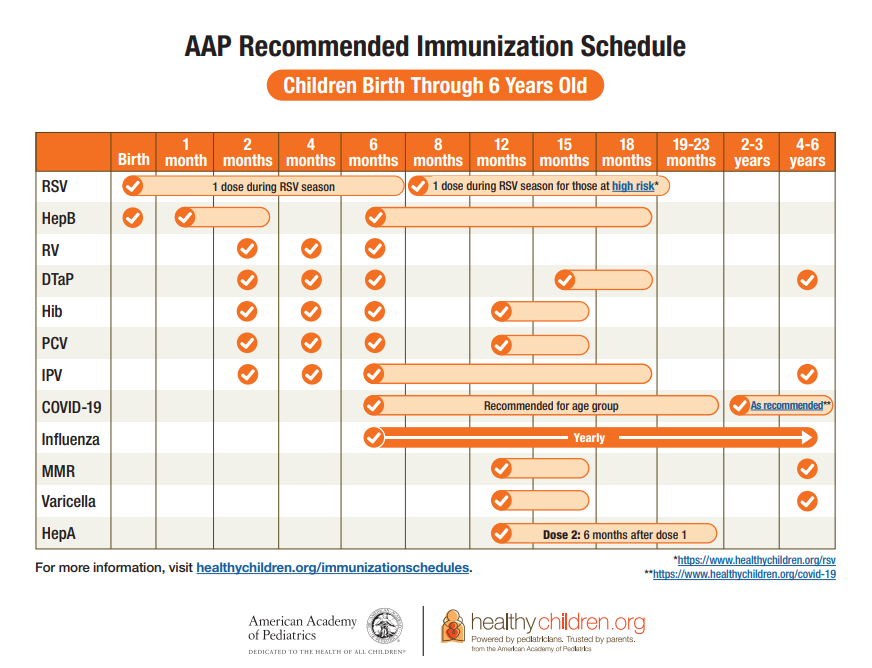
Piedmont Pediatrics continues to recommend the evidence-based American Academy of Pediatrics (AAP) childhood immunization schedule. Our office is still offering ALL vaccines from our original schedule.
Insurance companies are still covering the costs of these vaccines, just as they did previously.
The latest Human Health Services (HHS) changes, decreasing the recommended number of vaccines from 17 (18) to 11, are not based on any new trials or scientific studies and were announced without prior formal CDC input.
The AAP-backed childhood immunization schedule is based on decades old, meticulously reviewed data, designed to keep our nation's children healthy and protect against acute and chronic infections, hospitalizations, and death.
While HHS uses the phrase "shared clinical decision making" to imply that certain vaccines are less important than the others,
Piedmont Pediatrics believes that ALL the immunizations on the AAP-backed schedule are important and potentially life-saving. This is why we recommend ALL of them, with links
here, and at reliable sources such as
HealthyChildren.org and
CHOP.edu.
Pediatricians everywhere will continue advocating to keep ALL children safe from preventable infectious agents, including RSV, hepatitis A and B, diphtheria, tetanus, pertussis (whooping cough), haemophilus influenzae, pneumococcus, polio, rotavirus, measles, mumps, rubella, varicella (chicken pox), HPV, meningococcus (ACWY and B), influenza, and COVID-19.
More about the latest HHS recommendations:
- Why the AAP vaccine recommendations differ from the federal schedule(healthychildren.org)
- What parents should know about the new childhood immunization schedule (Yale School of Public Health)
"According to a 2024 CDC report, among children born in the United States between 1994–2023, routine childhood vaccinations will have prevented approximately 508 million lifetime cases of illness, 32 million hospitalizations, and 1,129,000 deaths, resulting in direct savings of $540 billion and societal savings of $2.7 trillion. During that same period, according to this report, vaccines no longer recommended by the CDC for all children under its new schedule prevented 6 million cases of hepatitis B (and 940,000 hospitalizations), 4 million cases of hepatitis A (and 78,000 hospitalizations), and 30 million cases of rotavirus (and over 800,000 hospitalizations).
“What we need to remember is that all of those vaccines that have been removed from the CDC’s recommended list and placed in the ‘choose-your-own adventure’ category prevent serious diseases that can make kids very, very sick,” Dr. Schwartz said. “Hep B, for instance, can lead to cirrhosis, liver failure, cancer, and death. Many of these symptoms can take decades to develop, and there is no cure.” - AAP's 2026 Immunization Schedule article (AAP News)
More about the birth dose of hepatitis B:
- Why do babies need the Hepatitis B vaccine?(healthychildren.org)
"Hepatitis B is a virus that can damage the liver and lead to lifelong health problems. The hepatitis B vaccine prevents short-term illness (acute hepatitis) and a life-threatening infection called chronic hepatitis B.
Newborns need the hepatitis B vaccine soon after birth. That's because they could be unknowingly exposed to
the virus during labor or shortly after coming home.
Other family members or caregivers can give hepatitis B to newborns. People often don’t know they are
infected with the virus because they may look and feel healthy.
Children infected at birth and in early childhood are much more likely to get chronic hepatitis B than adults.
The majority (90%) of infants infected at birth develop chronic hepatitis. That's why babies benefit most when
they get the vaccine early, during the first 24 hours of life."
More about the history of our recommended childhood immunization schedule:
- RFK Jr. wants to scrutinize the vaccine schedule – but its safety record is already decades long
(theconversation.com, December 18, 2025)
More on the misinformation regarding pediatrician reimbursements and profit from vaccines:
- Why This Nebraska Clinic Prioritizes Vaccines Over Profits: one pediatrician explains why vaccines are her biggest expense - not a cash cow (Unbiased Science Pod and Jen Covich Bordenick, December 13, 2025)
- Do pediatricians make large profits from vaccines? We followed the money (Statnews.com, January 29, 2026)
"Pediatricians are among the last bastions of trust in American health care — the ones who show up in 'Paw Patrol' scrubs when our kids are miserable, who answer panicked calls about fevers at midnight, and who chose one of the lowest-paid specialties in medicine because they wanted to care for children. Eroding trust in them has consequences. When parents are led to believe their pediatrician’s recommendations are driven by profit rather than their child’s health, they delay or decline vaccines. And children get sick.
If policymakers genuinely want to examine vaccine economics, they should ask why reimbursement rates vary so widely across states, why Medicaid payments often fall below delivery costs, and why the burden of protecting vulnerable children falls disproportionately on the practices least able to afford it.
The pediatricians we interviewed didn’t talk about bonuses. They talked about months-long waits for reimbursement, the impossible math of serving kids on Medicaid, and the kids themselves. The ones they’ve watched grow up. The families who trust them. They keep vaccinating, not because it’s profitable (it usually isn’t), but because it protects children.
Understanding the actual economics matters, because the physicians most committed to vaccinating children are often the ones making the least from it."